How to Choose Educational Toys for 3-Year-Olds by Skill

Summary
Choose educational toys for 3-year-olds by skill: hands, movement, words, pretend play, and building. See what to look for, what to skip, and piece size.
Choose a toy for a 3-year-old by the skill they are already practicing, not by the word “educational” on the box. One set of blocks, one soft ball, one doll, and one book cover more of the year than a pile of new toys. A toy can invite practice. It cannot guarantee a milestone.
This page is the age-3 shelf. The age-1 shelf, about 12 to 24 months, is in educational toys for 1-year-olds. The wider buying test, from babies through school age, is in the guide to choosing educational toys. Household versions of the same skills, when you are not buying anything, are linked under each skill below.
What most 3-year-olds are practicing
By 3 years, most children string large beads, use a fork, and put on some loose clothes, on the movement side of the CDC lists used in gross versus fine motor skills. Most also draw a circle when you show them how. On the social side, most calm down within about 10 minutes after you leave, and most notice other children and join them. Those lines are on the CDC 3-year checklist, which the social-emotional post cites as reviewed on 16 May 2026. Milestones are what 75% or more of children do by that age. They are not a shopping list or a screening test. The CDC explains that on its key points page.
A child who still puts toys in their mouth should keep the under-3 size rule even if the box says 3+. An object that fits entirely in the small-parts test, a cylinder 1.25 inches across and 2.25 inches deep, does not go on this shelf yet.
| Skill | What you watch them do | Look for | Leave behind |
|---|---|---|---|
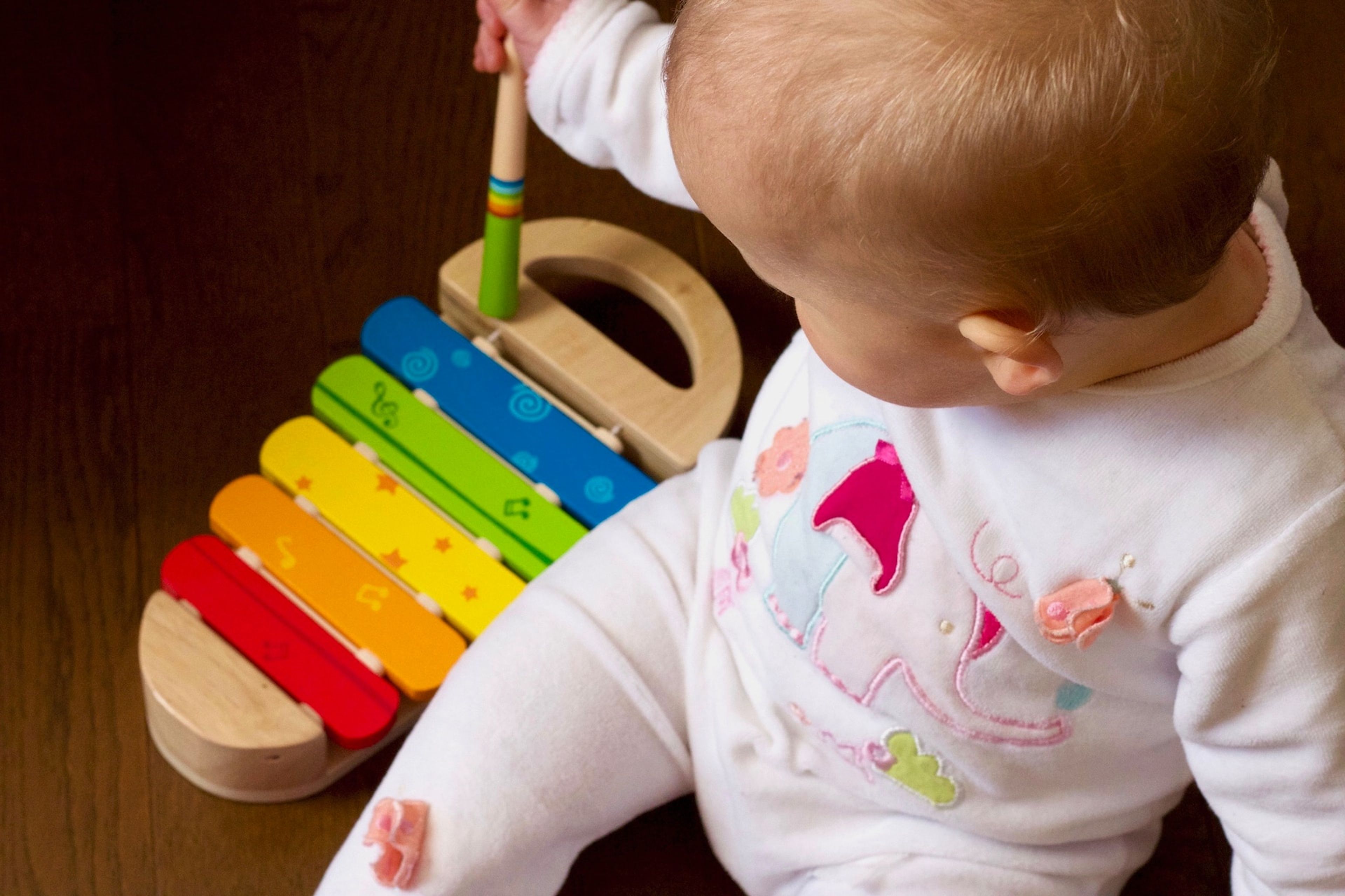
| Hands | String, stack, draw, dress a doll | Large pieces, a chunky crayon, a simple puzzle | Tiny beads if they still mouth toys |
| Movement | Kick, carry, climb only what is meant to be climbed | A soft ball much larger than 1.75 inches, a push toy | Trampolines, ride-ons near stairs |
| Words | Talk, turn pages, notice a letter | Board books, a puppet, dress-up | A toy that says every line for them |
| Pretend and feelings | Care for a doll, join another child | A doll, a hat, one short turn-taking game | A big set with a script they must follow |
| Building and sorting | Stack, sort, ask what happens | Blocks, a few sorting pieces, one question | A 100-piece kit, loose magnets |
| Senses | Pour, shake, touch one material | A taped water bottle, dough they do not eat, cloth | Rice, glitter, water beads |
NAEYC’s notes on toys by age point to materials children can use in more than one way. That is the filter for every row.
Hands
At 3, the useful toy gives the fingers a repeated job: push a large puzzle piece, stack a block, draw one circle, string a bead that is actually large. The preschool shelf for those hand toys is in fine motor toys for preschoolers. If your child is only just 3 and still mouths everything, stay with the larger household jobs in fine motor activities for toddlers.
Look for: pieces you can see across the room, a puzzle with a picture they recognize, a crayon short enough for their hand. “Large beads” in the CDC line means beads that fail the small-parts test, not seed beads.
Skip: lacing cards with tiny holes and beads they can inhale, and any set that needs you to place every piece. Scissors can wait for a single supervised snip, covered in the art activities post.
Movement
By age 2, most children kick a ball and walk up a few stairs with help. By 30 months, most jump off the ground with both feet. A 3-year-old’s movement toy should give them a reason to do those things in a clear space. The age-by-age list is in the motor-skills guide. Rainy-day versions that stay on the floor are in indoor gross motor activities.
Look for: a soft ball you can see is much bigger than 1.75 inches (44.4 mm). Balls that size or smaller, when meant for children under 3, are banned. A push toy with a wide base. A tunnel they crawl through on the floor, not a cushion pile.
Skip: indoor trampolines, ride-on toys in a room that opens onto stairs, and anything they are meant to jump off. Balloons stay out. The warning on latex balloons says children under 8 can choke or suffocate on balloons that are uninflated or broken.
Words and print
A 3-year-old’s language toy is usually a book, a puppet, or a hat that gives them a reason to talk. You still supply the interesting sentence. “Where is the hat going?” beats a button that announces the word hat.
Reading the story is its own skill, in reading aloud. Rhymes, first sounds, and finding one letter can start around now and fit better as they near 4 and 5. Those games are in reading readiness activities. Do not buy a letter magnet set to hurry that along.
Look for: a sturdy board book they can turn, a puppet with embroidered features, dress-up clothes without small buttons if they still mouth toys.
Skip: toys that play a full script so the child never has to speak, and loose magnetic letters. The CPSC magnet page says high-powered magnets are a risk from toddler age through the teen years.
Pretend play and feelings
Most 3-year-olds notice other children and join them, and most can calm within about 10 minutes after you leave. The toy that matches that is small and social: a doll to pat, a pot and a spoon, one game where they wait for a turn. Keep the group to one other child when joining is new.
What those toys look like is in social-emotional toys and pretend play. Games where the goal is shared, rather than one winner, are in cooperative play toys.
Look for: a doll or soft animal, a hat, a play food set with pieces too large to swallow, a matching or turn game that ends in a few minutes.
Skip: a 40-piece pretend set they will not use, and any rule so long that you are the one playing. If they only want to be the cook, let them be the cook.
Building, sorting, and one question
Blocks are the toy that can be a tower, a road, and a counting pile. At 3, the win is “which tower has more?” or “what keeps it standing?”, not a model with 80 steps. Those questions are written out in preschool STEM activities. A puzzle or a build with one finish line is also the concentration toy for this age, in toys for concentration.
Look for: a modest set of blocks or cups, a puzzle of about 4 to 12 chunky pieces, a sorter with a few shapes. You should be able to put half of it away and still have a game.
Skip: marble runs with small marbles, building sets with many tiny bricks, and anything with a battery door a 3-year-old can open. A coin-shaped battery is not a toy piece.
Senses, without a bin of rice
One material is enough: water in a taped bottle, store-bought dough they are not eating, or a piece of cloth. The activity list is in sensory play for toddlers. How to seal a bottle, and why glitter stays out, is in DIY sensory bottles.
Look for: a bottle you have already twist-tested, dough from a shop rather than raw flour, fabric that does not shed beads.
Skip: rice, beans, pasta, water beads, and “calm down” jars full of glitter. The CPSC water-bead alert says to remove water beads from places with children 3 and younger.
How many to have, and when to buy
There is no researched correct number of toys for a 3-year-old. Use the table as a check, not a cart. If they already stack blocks every day, another block set can wait. Buy when a skill has no material at all, or when the pieces they have are cracked, too small, or too frustrating to repeat.
Start with what is in the house. A book, a ball, a doll, a crayon, and a box of blocks cover the six rows. The activity posts linked above are the no-purchase versions.
Put out one or two toys. A floor covered in every new thing makes choosing the game harder, which is the opposite of the concentration advice: one finish line.
Check the maker’s age label, then check the child. A label of 3+ means the product was graded for that age, including small-parts rules for younger children. It does not mean every 3-year-old is done putting things in their mouth. If yours still mouths toys, shop the under-3 size.
The shop is the CottageForTots Shopee store. Before you buy a ball, a puzzle, or a bead set, check the piece size against the small-parts cylinder and the ball rule above.
Frequently asked questions
What educational toys does a 3-year-old need?
A few they will use: something to stack or puzzle, something to kick or push, a book or a puppet, a doll or dress-up piece, and one sensory material that is not a choking hazard. Match the toy to the skill you see this month.
Are electronic learning toys a good buy at age 3?
Sometimes, when the child still has to do something: press, match, or turn a page. A toy that speaks every word and plays the whole game leaves them less to say. Prefer the book, the blocks, or the doll when the goal is language or pretend play.
What if my 3-year-old still mouths toys?
Treat the shelf like an under-3 shelf. Large pieces only. No water beads, no tiny beads, no loose magnets, no balloons. Stringing can wait until the beads are truly large and the mouthing has stopped.
Do I need a separate toy for each skill?
No. Blocks can be a tower, a road, and a handful to count. A doll can be pretend play and language. The table is a way to notice a gap, not a requirement to own six categories.
How is this different from the main toy guide?
The main guide covers babies through school age and the general buying test. This page is only age 3, sorted by the skill the toy is for, with the activity posts that replace a purchase.
What to try first
Watch one play session. Write down the skill they repeat: stacking, kicking, talking to a doll, or pouring. Get or pull out one toy for that skill. Leave the other five rows for another week.
Then read the matching activity post linked above, and the educational toys guide if you want the safety check in full.