15 Fine Motor Activities for Toddlers Using Everyday Items

Summary
Try 15 fine motor activities for toddlers with cups, paper, and a sponge. Includes easier versions and choking notes for children who still mouth objects.
A toddler’s hands get stronger by posting a block, tearing paper, scribbling, and using a spoon. You do not need tweezers, beads, or a rice bin. One large object, repeated a few times, is the whole activity.
Fine motor skills are the movements of the hands and fingers: grasping, releasing, pinching, twisting, and making a mark. The age-by-age picture, from a whole-hand hold to a pincer grasp, is in what fine motor skills are. This page is the at-home version for about 12 to 36 months.
These activities are practice. They are not a test, and they are not treatment for a delay.
Match the job to the hand they have
The CDC’s Learn the Signs. Act Early. checklists describe what about 75% or more of children do by a given age. They are not a screening test. The movement list, sorted into hand skills, is already in how fine motor skills develop. Use it as a starting point, then follow the child in front of you.
| About | What most children do | A matching activity |
|---|---|---|
| 18 months | Scribble. Try a spoon. Finger-feed. | Chunky crayon. Spoon with large pieces. |
| 2 years | Eat with a spoon. | The real snack, with the spoon. |
| 30 months | Twist lids and doorknobs. Turn one book page. Take off some loose clothes. | One large lid. A board book. A hat. |
| 3 years | Use a fork. Put on some loose clothes. Draw a circle after you show one. String large items. | A fork at a meal. Tearing paper. Stringing only if every piece is too big to choke on. |
Sources: CDC checklists for 18 months, 2 years, 30 months, and 3 years. The 30-month page, reviewed 16 May 2026, also suggests crayons, a straight line to copy, and stickers on a large box.
Let them use whichever hand they reach with. You do not need to switch them to the other hand.
Fifteen activities
Skip any piece that fits entirely, without squeezing and in any orientation, inside the U.S. Consumer Product Safety Commission small-parts cylinder (1.25 inches across and 2.25 inches deep). That rule is for products intended for children under 3. Household objects are not tested like toys. If your child still mouths things, treat the cylinder as the line.
| Activity | Hand action | Easier | Harder |
|---|---|---|---|
| Spoon large pieces | Grasp and release | You load the spoon | They scoop one sock-ball |
| Post into a hole | Aim and let go | A wide bowl | A smaller opening, still larger than a mouth |
| Stack three cups | Place and balance | Two cups | A fourth cup |
| Tear paper | Pinch and pull | A slit already started | A strip they start themselves |
| Scribble | Hold and mark | Paper taped down | A line they try to copy |
| Large stickers | Pinch and press | You peel, they stick | They peel one corner |
| Twist a lid | Turn the wrist | Lid already loose | They start it closed |
| Turn a page | Isolate the fingers | A board book | One page, not a handful |
| Take off a hat | Pull with both hands | You start the hat | Loose pants, they finish |
| Squeeze a sponge | Whole-hand strength | A wet sponge | Squeeze into a cup |
| Poke dough | Finger pressure | One poke | Roll a short log |
| Clip a clothespin | Pinch against a spring | Skip if the spring is fierce | Two clips on a box edge |
| Peel a banana | Pull while the other hand holds | You start one strip | They pull the strip off |
| Simple puzzle | Turn and fit | One knob piece | Two or three large pieces |
| Pour a little water | Steady two hands | Onto a sponge | Cup to cup |
1. Spoon large pieces
Materials: two bowls, a short spoon, and socks rolled into balls. No beans, rice, or beads.
Try it: Scoop one ball and drop it in the empty bowl. Offer the spoon.
Easier: You put the ball on the spoon. They carry it across.
Harder: They scoop from a pile. The longer “finish and put away” version is in Montessori-inspired activities.
2. Post a toy into a hole
Materials: a wide plastic jar or a box with a hole cut in the lid, and one ball or block that is too big to swallow. The hole should be larger than the toy and still too small for a hand to get stuck.
Try it: Drop one toy in. Let them shake the container, then tip it out together.
Easier: Drop into an open bowl, so aiming is the only job.
Harder: Two different toys and two holes, only if both toys are large.
3. Stack three cups or blocks
Materials: three plastic cups or large blocks.
Try it: Set one on another. Hand them the third.
Easier: They knock the tower down. The release is still the skill.
Harder: A fourth piece, or cups nested and then stacked.
4. Tear a strip of paper
Materials: a strip of scrap paper, about the width of their hand. Newspaper ink can rub off, so use plain paper if they put things in their mouth.
Try it: Pinch the top edge with both hands and pull apart. If the paper will not start, cut a tiny slit for them.
Easier: You hold one side.
Harder: They tear a few pieces and stick them on a large piece of tape.
Save scissors for later. A child health hand-skills sheet from Western Australia says cutting fits around age 3, with the thumb on top. Stay beside them. It is not a toddler activity on this list.
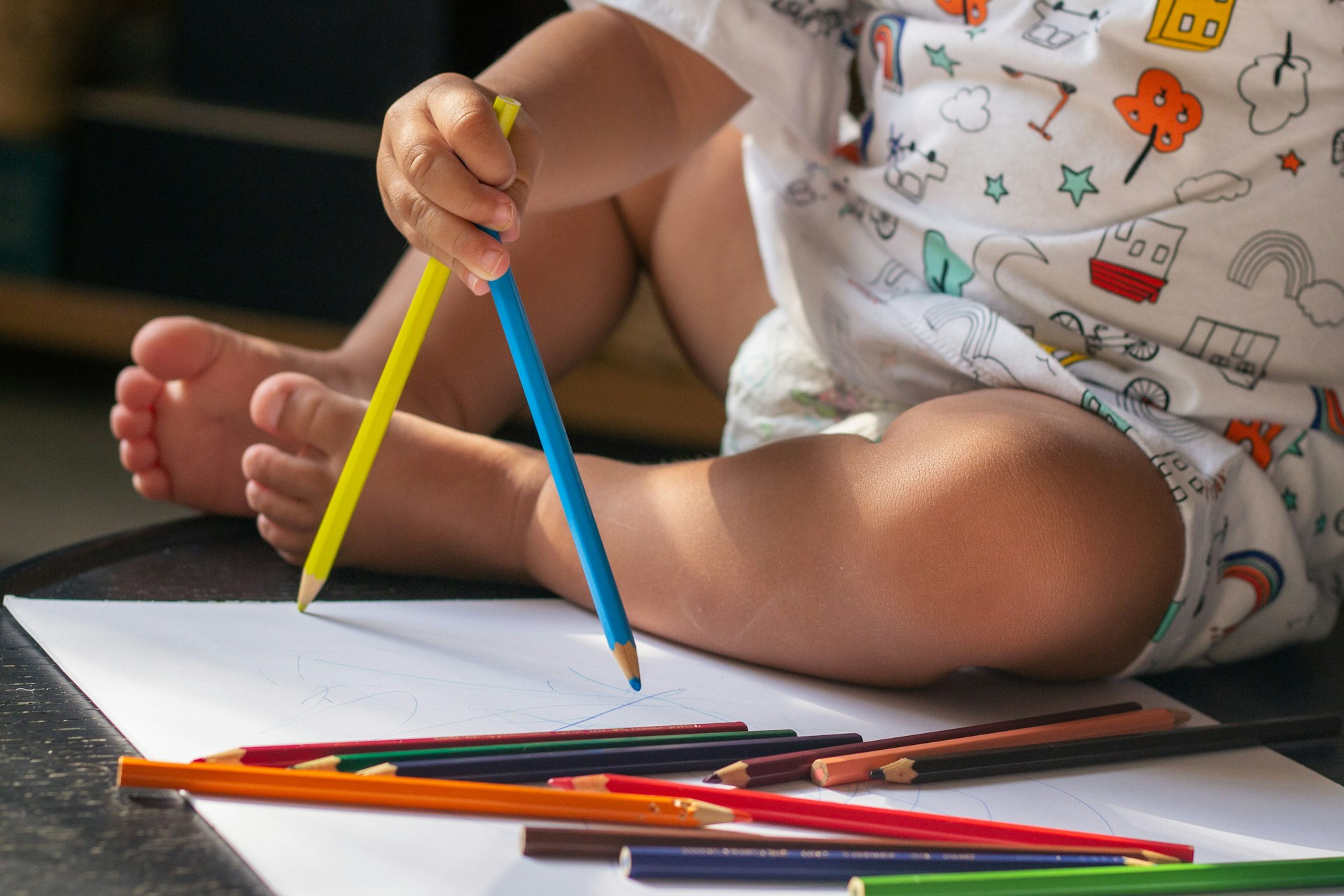
5. Scribble on taped paper
Materials: a chunky crayon and paper taped to the table, so the other hand does not have to chase the page.
Try it: Make one mark. Leave the crayon. CDC’s 30-month ideas include drawing on paper, copying a straight line, and later a circle. At 18 months, scribbling itself is the milestone. Do not ask for a picture.
Easier: You hold the crayon with them for one stroke, then let go.
Harder: Paper on a wall or an easel, so the shoulder works too. How marks turn into drawing is in scribbles in early childhood.
6. Press on a large sticker
Materials: one or two large stickers, and a cardboard box. CDC’s 30-month tips include putting stickers on a big box.
Try it: Peel a corner if they cannot start it. They press the sticker on the box.
Easier: The sticker is already peeled. They only press.
Skip: Sticker sheets of tiny dots, foam stickers that tear into bits, and anything that fits in the small-parts cylinder.
7. Twist one large lid
Materials: a wide plastic jar with a lid their whole hand can hold. Put a familiar toy inside.
Try it: Loosen the lid. They finish the turn and take the toy out. By 30 months, most children use their hands to twist things such as doorknobs and lids. Younger toddlers can still practice on a lid you have already started.
Easier: The lid rests on top, unscrewed. They lift it off.
Skip: Tiny bottles and lids that come off as a small piece.
8. Turn one page
Materials: a board book with thick pages.
Try it: Read one page. Lift a corner. Let them finish the turn. The CDC lists turning pages one at a time by 30 months. A handful of pages still counts as trying.
Easier: You turn, they pat the picture.
Harder: A magazine page, supervised, because thin paper tears into scraps they may mouth.
9. Take off a hat or loose pants
Materials: their own hat, or pants that are already loose at the waist.
Try it: Start the hat at the ears. They pull. By 30 months, most children take off some clothes, such as loose pants or an open jacket. You do the parts that need balance.
Easier: Only the hat.
Harder: They pull one sleeve of an open jacket. Buttons and zippers can wait. Toy versions of those fasteners, sized for preschoolers, are in fine motor toys for preschoolers. That list includes beads and laces. Use it from about age 3, not for a toddler who still mouths objects.
10. Squeeze a sponge
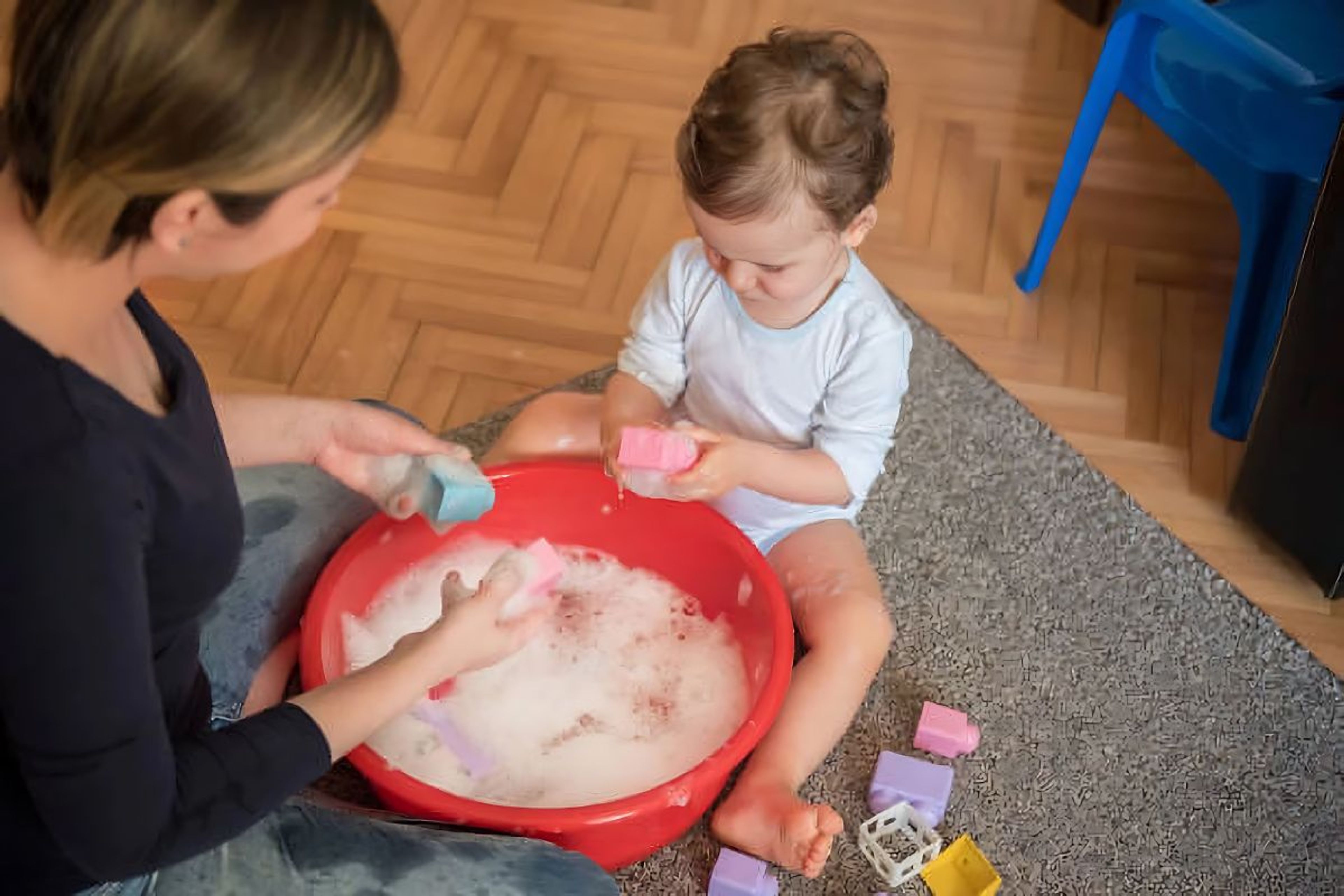
Materials: a clean sponge and a cup with a little water, on a tray.
Try it: Dip, lift, squeeze over the cup. Offer the sponge.
Easier: The sponge is already wet. They only squeeze.
Harder: They dip it themselves. Stay for the water, and empty the cup before you leave. More wet play is in sensory play activities for toddlers.
11. Poke store-bought dough
Materials: a small lump of commercial play dough on a tray.
Try it: Flatten it. Poke one hole with a finger. Let them poke, squeeze, or roll a short log.
Do not make dough from raw flour. The CDC says children should not play with dough made from raw flour, because most flour is raw and can contain germs. The full note, and what to do if they hate sticky hands, is in the sensory play article.
Easier: They only squash it.
Skip dough if they eat whatever they touch. Wash hands when you stop.
12. Clip a clothespin on a box
Materials: one large plastic clothespin and the rim of a cardboard box or a plastic cup.
Try it: Pinch it open and clip it on the rim, not on skin. Show it once.
Easier: Skip this until their pinch is strong. Activity 6 uses a softer pinch.
Stop if: The spring is so strong it snaps shut on a finger, or the pin comes apart. A loose spring is a small part. Throw that pin away.
13. Peel one strip of banana
Materials: a ripe banana they are allowed to eat. No allergy to it.
Try it: You split the top. They pull one strip down while you hold the fruit. Then they can eat it.
Easier: You peel, they pull the last bit of strip.
Skip: Whole grapes, nuts, popcorn, and chunks they cannot manage at meals. This is a hand job with a familiar food, not a new choking risk.
14. Fit one puzzle piece
Materials: a knob puzzle or shape toy with few pieces, labeled for children under 3. Every piece large.
Try it: Take one piece out. They put it back, using the knob.
Easier: The piece starts half in the hole.
Harder: Two pieces. Check that none are cracked or small enough to choke. Age labels are covered in safe toys for infants.
15. Pour a little water
Materials: two open cups, a tray, a sponge, and a few tablespoons of water.
Try it: Pour once. Hand them the cup. The two-handed hold is the fine motor part. The walking and carrying, if you add them, are the gross motor part.
Easier: Pour onto a sponge.
Stay beside them. Empty the cups before you leave the room. Young children can drown in very little water. The American Academy of Pediatrics notes that on HealthyChildren.org, including the reminder to empty containers after use.
How to make it easier without a lecture
Change one thing. Fewer objects, a bigger hole, or you doing the first step. Add a challenge only after the current version is calm.
Stop while they are still willing. A few minutes is a normal try. End it when they leave, or when a piece goes toward a mouth and should not.
If every activity ends in frustration, go back to stacking and tearing. Those ask for less aim. If you are worried they have lost a skill, or a milestone on the CDC list is missing and it concerns you, talk with your child’s doctor and ask about developmental screening. The checklists say the same thing.
A wooden puzzle, a chunky crayon, or a cup from this shop is in the CottageForTots Shopee store. Check the piece size before you buy. How a toy earns a place past a single activity is in the guide to choosing educational toys.
Frequently asked questions
What are fine motor activities for toddlers?
They are short jobs that make the fingers grasp, release, pinch, twist, or mark. Spooning, posting, tearing, scribbling, and turning a lid all qualify. The activity fits a toddler when the pieces are large and the child can repeat it without a worksheet.
Do I need special fine motor toys?
No. Cups, paper, a crayon, a sponge, and a board book cover this list. A knob puzzle labeled for under 3 is the one item worth buying if you do not already have a simple puzzle. Bead sets, lacing cards, and tongs are a better fit around ages 3 to 5, and that shelf is in the preschool toy guide.
Can toddlers use beads, pasta, or tweezers?
Not as a default. Dry pasta, cereal, and small beads are easy to choke on, even if you are in the room. Tweezers make that problem smaller and harder to see. Use rolled socks, large blocks, paper, and dough instead. Stringing is a CDC example at age 3 for large items, and only when each piece fails the small-parts check.
How long should a fine motor activity last?
As long as they are involved, and not longer than you can watch water or loose pieces. Many tries last a few minutes. You do not need a timer.
Should I correct their grip?
Show a chunky crayon once, between fingers and thumb, then let them hold it in a fist if that is what works. The CDC’s shift from a fist hold toward fingers and thumb shows up later, around age 4, not as a toddler drill. Forcing a pencil grip at age 2 usually ends the scribbling.
What to try first
Tape down a sheet of paper and hand over one chunky crayon. If they are done in a minute, stack three cups instead.
Put the materials away afterward so the next try is a choice. If you want the age chart before you pick an activity, start with gross versus fine motor skills.