12 Montessori-Inspired Activities for 2-Year-Olds at Home

Summary
Try 12 Montessori-inspired activities for 2-year-olds with cups, socks, and a cloth. Materials, steps, and choking notes for children who still mouth objects.
A 2-year-old can pour, wipe, match, and carry if the job is real and the pieces are large. You do not need a shelf of official Montessori materials to start. One tray, a slow demonstration, and a chance to repeat the same job will teach more than a pile of new toys.
These activities are Montessori-inspired. They borrow ideas from Montessori practical life. They are not a Montessori school lesson, and they are not certified by the Association Montessori Internationale.
What “Montessori-inspired” means at home
The Association Montessori Internationale describes practical life as ordinary home work: sweeping, dusting, washing dishes, and looking after oneself. The point is a real result. The child coordinates hands and attention, then sees that they contributed.
AMI also describes how an adult shows the work. The demonstration is slow, exact, and short on words. After that, the child is free to try and repeat. Materials are child-sized. A spill, a leftover sock, or a piece that only fits one hole tells the child what happened. Montessori called that feedback a control of error. You do not have to announce the mistake.
A home is not a prepared classroom with a trained guide. Use the parts that travel: one real job, tools the child can lift, a clear start and finish, and your willingness to let them do it slowly.
Ages here mean about 24 to 36 months. Some 2-year-olds will want the shortest version. Some will repeat one job for a long time. Follow the child in front of you.
Set out one activity
Pick a low surface the child can reach without climbing. A floor mat or a small table both work. Clear everything else off it.
Put only the pieces for one activity on a tray or in a shallow basket. Include the cloth or sponge they will use to finish. Show the whole sequence once: carry the tray, do the job, wipe the spill, return the tray. Then step back.
Stay in the room. Two-year-olds still need you for water, climbing, and anything that can go in a mouth. Help when they ask, or when something is unsafe. Redoing the job while they are still trying usually ends the repetition.
If the work falls apart, make it shorter next time. Offer fewer objects, a larger tool, or only the last step. For how hand skills and whole-body skills fit together at this age, see gross and fine motor skills.
Twelve activities
Each one uses things you already have. Skip any object your child still puts in their mouth if it is small enough to choke on. The safety section below explains the check.
| Activity | Materials | Stay beside them? | Mess |
|---|---|---|---|
| Pour water | Two cups, tray, sponge | Yes | Wet |
| Spoon large pieces | Two bowls, spoon, rolled socks | Yes, if pieces could be mouthed | Low |
| Sort by type | Two baskets, large safe objects | Watch mouthing | Low |
| Match socks | Four to six of the child’s socks | No, if socks stay in hand | Low |
| Wipe the table | Damp cloth | Nearby | Damp |
| Open and close | Two or three large containers | Yes, if lids come off | Low |
| Water a plant | Tiny watering cup, one plant | Yes | Wet |
| Set one place | Plate, cup, spoon, napkin | Nearby | Low |
| Simple puzzle | Knob puzzle or shape toy labeled for under 3 | Check pieces first | Low |
| Carry a tray | Empty tray, then a light object | Nearby | Low |
| Fold a cloth | One washcloth | No | None |
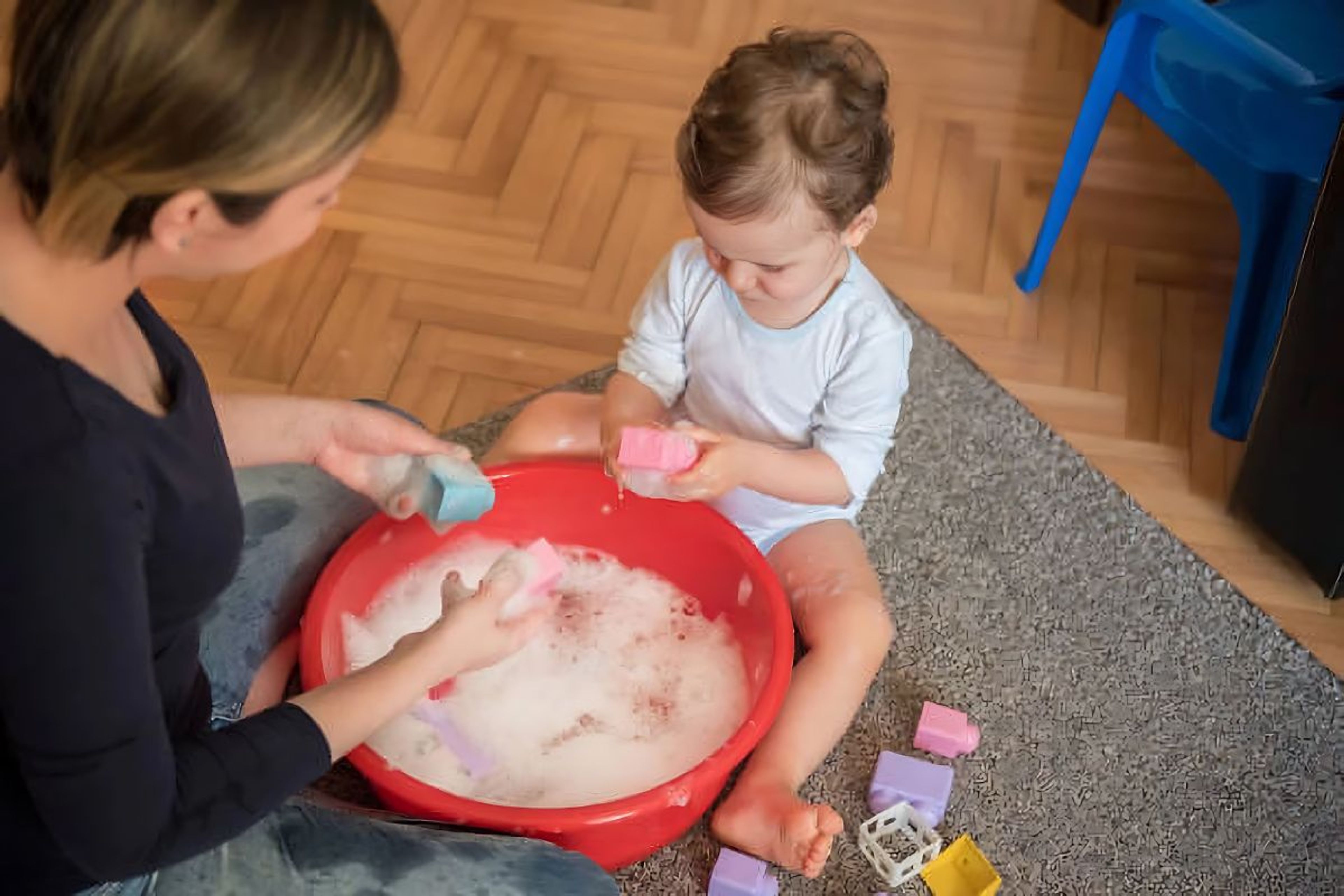
| Wash one cup | Basin with a little water, cup, towel | Yes | Wet |
1. Pour a small amount of water
Materials: two open cups that do not tip easily, a tray with a lip if you have one, a sponge.
Setup: Put a few tablespoons of water in one cup. Leave the other cup empty. Park the sponge on the tray.
Steps: Sit beside your child. Pick up the full cup, pour slowly into the empty one, and set the cup down. Wipe one drip with the sponge. Hand them the cup.
What you might see: A flood on the first tries, then a slower pour. Many children will pour back and forth long after the “lesson” is over. That repetition is the activity.
Cleanup: They squeeze the sponge into the empty cup, or you do that last step together. Empty the cups before you leave the room.
Easier version: They pour onto a sponge in a bowl, so there is nowhere for a puddle to spread. Skip this activity if you cannot stay within reach. Even a shallow tray of water needs an adult present the whole time.
2. Spoon large pieces, not beans or rice
Materials: two bowls, a short spoon, and objects too big to swallow, such as socks rolled into balls.
Setup: Fill one bowl. Leave the other empty. Both bowls sit on the tray with the spoon.
Steps: Scoop one piece, carry it over the gap, and drop it in the empty bowl. Then offer the spoon.
What you might see: The spoon used as a shovel, then as a spoon. Pieces dropped on the tray are part of the work if a small brush or their hand can pick them up.
Cleanup: Tip the pieces back into one bowl and return the tray.
Do not use: Dry beans, rice, beads, pasta, or pom-poms small enough to fit in a mouth. Those are common in Montessori photos and they are a choking hazard at age 2. If your child still mouths everything, skip loose pieces and use activity 5 or 11 instead.
3. Sort large objects by type
Materials: two baskets, and two kinds of large objects. Examples: the child’s socks in one group and plastic cups in the other. Four to six items total is enough.
Setup: Mix them in a pile between the baskets.
Steps: Place one sock in the sock basket and one cup in the cup basket. Leave the rest.
What you might see: Sorting by type, or a new game you did not plan. If they are interested, stop correcting.
Cleanup: They put each basket back on the shelf.
Easier version: Only three objects, already half-sorted. Harder version: sort by color only when every object is large and dull-edged.
4. Match sock pairs
Materials: two or three pairs of the child’s own socks, unpaired.
Setup: Lay them in a row.
Steps: Hold up one sock. Find its partner and put the two together. Offer the next sock.
What you might see: Matching by color, or stuffing every sock into a ball. Either one is hand practice. Name the match only if they look at you for a word.
Cleanup: The pairs go into the drawer, which is the real end of the job.
Easier version: One pair, plus a third sock that obviously does not match.
5. Wipe the table after a snack
Materials: a small damp cloth. Water only, no spray cleaner.
Setup: Wait until crumbs are actually there. Hand them the cloth.
Steps: Show one wipe from the middle toward the edge, then let them continue. Shake the crumbs into the bin together.
What you might see: Scrubbing one spot for a long time. That is concentration, not a missed spot you must fix.
Cleanup: Hang the cloth where they can reach it next time.
Safer version: Skip bleach, disinfectant spray, and vinegar bottles. A chemical bottle is not a toddler tool. If you want a routine for real wooden toys later, that is a different job, covered in how to clean wooden toys.
6. Open and close large containers
Materials: two or three containers with different closures: a large snap lid, a screw-top jar that their hands can grip, a box with a flap. Put a familiar toy inside one of them.
Setup: Containers start closed. The toy is inside the easiest one.
Steps: Open one, take the toy out, close it, and put the toy back. Offer the next container.
What you might see: Opening without closing. Show the close once, then let the open be the win for today.
Cleanup: Lids go back on before the containers return to the shelf. A loose small lid is the hazard, not the opening practice.
Skip: Tiny bottles, coin purses, and anything with a lid that detaches into a small piece.
7. Water one plant
Materials: a small cup or child-sized watering can with a little water, one sturdy plant at their height, a towel under the pot.
Setup: Fill the cup halfway at most. Mark the level with a rubber band if the cup is clear, so they can see “this much.”
Steps: Carry the cup with two hands. Pour at the soil, not the leaves. Set the cup on the towel.
What you might see: One careful pour, or the whole cup at once. The towel is there for the second one.
Cleanup: They pat the towel. You empty any leftover water.
Skip: Glass vases, plant food, and any plant you would not want touched or tasted. Stay for the pour.
8. Set one place at the table
Materials: one plate, one cup, one spoon, one napkin. A placemat with simple outlines helps. Draw them on paper and tape the paper down if you do not want to buy one.
Setup: The four items sit on a tray to the side of the mat.
Steps: Put the plate on its spot, then the cup, the spoon, and the napkin. Eat the snack there so the work has a point.
What you might see: The spoon on the plate, or the napkin as a hat. Put the hat back on the outline once, without a speech.
Cleanup: They carry the cup and spoon to the sink. You handle anything breakable.
Easier version: Only the cup and the napkin.
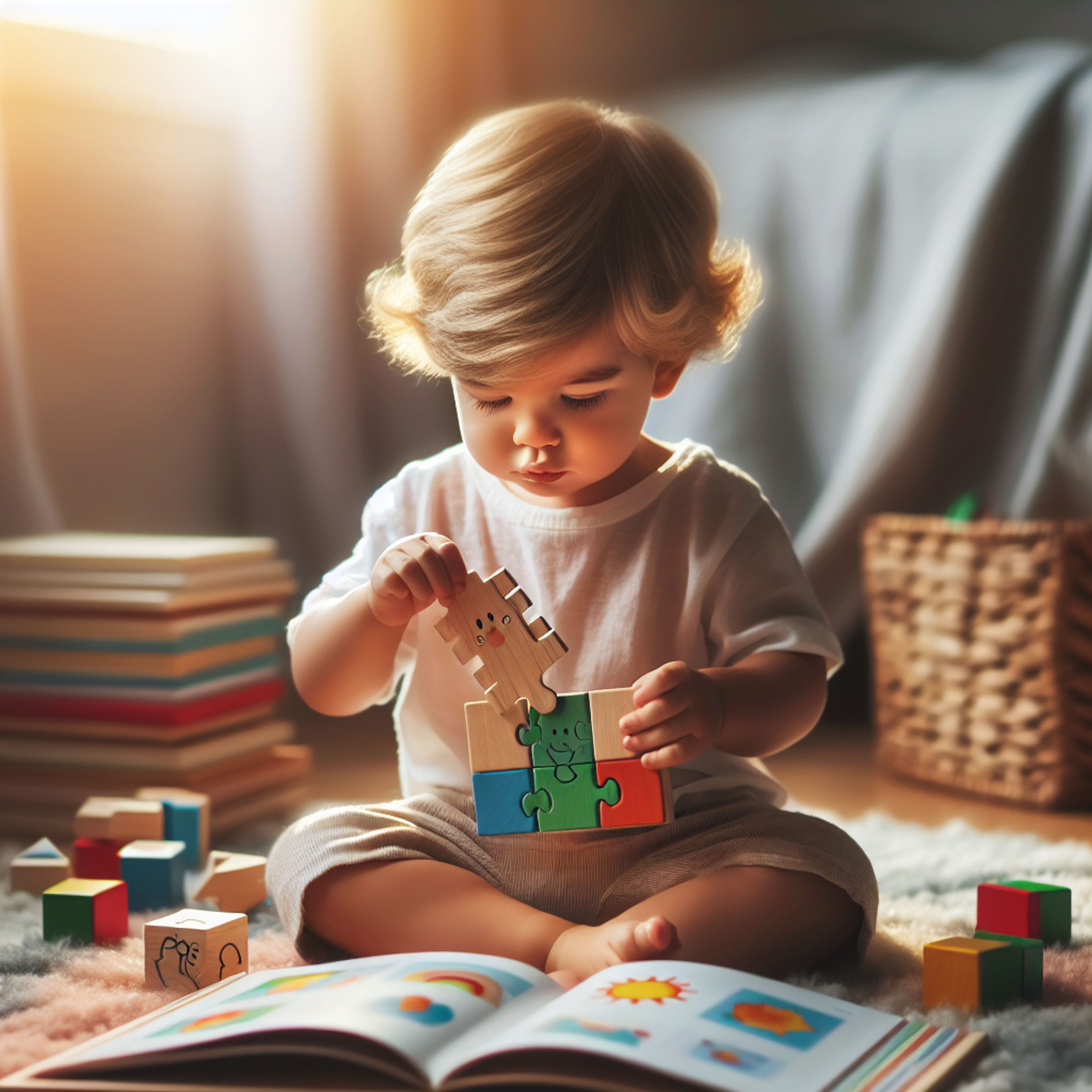
9. Use a simple puzzle
Materials: a wooden knob puzzle or a shape toy with few pieces, labeled for children under 3. Every piece should be large.
Setup: Take the pieces out. Leave the board empty.
Steps: Fit one piece, using the knob. Take it out again so they can see it move both ways. Hand them a piece.
What you might see: Pieces dumped, then one piece posted over and over. One piece finished is a complete cycle.
Cleanup: Pieces go back in the board before the puzzle goes on the shelf. Check that none are loose, cracked, or small enough to choke.
If you buy one: Read the age label and look at the pieces yourself. Age labels and infant toy checks are covered in safe toys for infants. The same size rule still matters at age 2.
10. Carry a tray across the room
Materials: a light tray with a rim. Start empty. Later, add one unbreakable cup.
Setup: Mark a start spot and an end spot, both at child height. The path should be clear.
Steps: Pick up the tray with two hands, walk, and set it down flat. Walk back without it.
What you might see: Very slow walking, or a run that spills the cup. Return to the empty tray.
Cleanup: The tray lives in one spot, so getting it out and putting it back are part of the job.
Easier version: Carry a small pillow or a board book instead of a tray.
11. Fold a washcloth
Materials: one dry washcloth.
Setup: Lay it flat on the table.
Steps: Fold once, matching corner to corner as well as a 2-year-old fold allows. Crease it with a hand. Offer them the cloth unfolded.
What you might see: A wad, not a square. The wad still used two hands together. Stop while they are willing to try another cloth tomorrow.
Cleanup: The cloth goes on a low hook or into a basket they can reach.
Harder version: Fold, then place it on the table beside activity 8.
12. Wash one plastic cup
Materials: a basin with an inch of water, one plastic cup, a small cloth, a towel.
Setup: Basin on a towel, on the floor or a low table. You fill it. They do not carry a full basin.
Steps: Dip the cloth, wipe the cup, rinse it in the basin, and set it on the dry side of the towel.
What you might see: More washing of the cloth than of the cup. Trade once: you hold the cup, they wipe.
Cleanup: They help tip the basin into the sink only if you are holding it with them. Empty it before you turn away.
Allergy and taste note: Washing a vegetable is the same setup, and it adds food. Skip it if the food is a choking shape, a known allergen, or something they are not meant to eat yet. A plastic cup keeps the lesson on washing.
If your child still mouths objects
Choose activities 5, 8, 10, and 11 until mouthing settles. Those use cloths, a cup you are watching, a tray, and a book or pillow.
For loose objects, use the U.S. Consumer Product Safety Commission rule for children under 3. A small part is anything that fits, without squeezing and in any orientation, entirely inside the small-parts cylinder. That cylinder is 1.25 inches across and 2.25 inches deep. Toys intended for children under 3 that have small parts are banned. Household objects are not tested like toys. If a bead, bean, lid, or puzzle piece would fit entirely in that cylinder, do not hand it to a 2-year-old.
Stay for every activity that uses water. Empty trays and basins before you leave, including for a minute.
How to change the challenge
Make it easier by removing objects, shortening the sequence, or doing the first step yourself and leaving the last step to them.
Make it harder only after the current version is calm. Add one more sock, a second plant, or the walk back to the shelf. Do not add small pieces to make it “more educational.”
Some children need the work to move. Carry the tray, then stop. Some need the work to stay on the table. Wiping and folding are enough. Interest is a better guide than a checklist of all 12.
One job a day is plenty. Leaving the same tray out for a week beats introducing a new one every morning. When they stop choosing it, put it away for a while.
How a toy earns a place on the shelf, beyond a single activity, is in the guide to choosing educational toys. If you want a wooden puzzle or a child-sized pitcher later, the shop is the CottageForTots Shopee store. Check the piece size before you buy.
Frequently asked questions
Do I need Montessori toys for a 2-year-old?
No. Cups, socks, a cloth, and a tray cover the activities on this page. A knob puzzle labeled for under 3 is the one item worth buying if you do not already have a simple puzzle. Official Montessori materials are designed for a classroom. They are optional at home.
How long should a 2-year-old stay with one activity?
As long as they are involved, and not longer than you can supervise water or small objects. Many tries last a few minutes. Some children repeat pouring much longer. End it when they leave, or when you must leave. You do not need a timer.
Why not use rice, beans, or sensory bins?
Rice, beans, beads, and small pasta are easy to inhale or choke on at this age. A 2-year-old who is still mouthing objects should transfer large pieces, such as rolled socks, or skip transferring and wipe, fold, or carry instead. Larger, supervised options are in sensory play activities for toddlers.
What if they refuse the activity?
Put the tray where they can see it and use it yourself once, slowly, while they watch. If they walk away, the activity can wait. Forcing a “lesson” removes the choice that makes the repetition useful.
Is this the same as a Montessori program?
No. A Montessori classroom is prepared by a trained adult, with a specific set of materials and a mixed-age group. These are home versions of practical-life ideas: real work, a short demonstration, and a chance to repeat. Calling them Montessori-inspired is accurate. Calling them a Montessori education is not.
What to do next
Pick one activity you already do, such as wiping the table or matching socks. Show it once. Leave the materials where your child can try again tomorrow.
If hand skills are the part you want to understand before you add puzzles, start with gross versus fine motor skills. If a wooden toy joins the tray, clean it with a damp cloth rather than a soak, using the wooden-toy method.