15 Reading Readiness Activities for Preschoolers at Home

Summary
Try 15 reading readiness activities for preschoolers using rhymes, first sounds, and print. Short home games for about ages 3 to 5, with no letter magnets.
A preschooler gets ready to read by hearing that spoken words have parts, and by noticing that print carries a message. You can practice both with a book you already own and one short sound game. Letter magnets and a stack of flashcards are optional, and the small magnetic ones are the kind to leave out.
This page is for about ages 3 to 5. How to read a story aloud, with voices and questions, is in reading aloud for language. The games below are the sound and print work that sits next to that story.
What reading readiness is
Reading readiness here means two habits. One is phonological awareness: hearing that a word can break into parts, such as a rhyme, a first sound, or a clap for each syllable. The other is print awareness: knowing that marks on a page are read in a direction, that a letter has a name, and that print can be a list or a name card.
The What Works Clearinghouse practice guide Preparing Young Children for School (August 2022) gives letter and sound instruction a strong evidence rating, from nine studies that met its standards without reservations. The panel’s order is to listen for sounds in words first, then introduce a letter and the sound it makes, then practice, then notice print during the day. Shared book reading has a strong evidence rating too, from 17 studies. Those ratings come from preschool classroom programs. A rhyme at the kitchen table is the same kind of skill in a shorter form. It is not those programs, and it does not mean a child will read early.
A regional education lab note for teachers says phonological awareness is a heard skill. It does not require a written word. The same note says rhyming songs and clapping with a whole class are not enough, on their own, for every child. The useful borrow at home is a short game you repeat, aimed at one skill.
NAEYC’s winter 2024 piece on word play lists rhymes, words that start alike, clapping syllables, and counting the words in a sentence. It also says children do not have to master one of those before they meet another, and that the games should include the language the family speaks at home.
What most children do, and what can wait
By 4 years, most children tell what comes next in a well-known story, on the CDC 4-year list. By 5 years, most use or recognize simple rhymes, such as bat and cat, name some letters when you point to them, and write some letters in their name. The 5-year page was reviewed on 16 May 2026. Milestones are what 75% or more of children do by that age. They are not a reading test. The CDC explains that limit on its key points page.
A 3-year-old can still listen for a rhyme and turn a book around. Do not ask them to name the alphabet. One letter, the first letter of their name, is enough until they notice it in other places.
The practice guide says to call letters uppercase and lowercase, not big and little. “Big” makes children think about the size of the print. Show both forms when the book has both, and use those two words.
Some dialects drop sounds at the ends of words. The practice guide says those children need more time with end sounds, and that it helps to start with sounds at the beginning of words. Play the game in the dialect and the language you actually speak. A home language is not a wrong answer.
| Activity | Skill | Materials | You join? |
|---|---|---|---|
| Thumbs-up rhymes | Rhyme | None | Yes |
| One silly rhyme | Rhyme | None | Yes |
| A word like their name | First sound | None | Yes |
| Clap the parts | Syllables | None | Yes |
| Count the words | Sentences | Your fingers | Yes |
| I spy a sound | First sound | The room | Yes |
| Turn the book | One book | Yes | |
| Point along a line | Print direction | The same book | Yes |
| Find their letter | Letter name | Book or a sign | Yes |
| Write that letter once | Letter shape | Paper, crayon | Yes |
| Which card is their name | Two cards | Yes | |
| A one-item list | Print has a job | Paper | Yes |
| What happens next | Story | A familiar book | Yes |
| Two things that happened | Retell | The same book | Yes |
| One sign outside | Print in the world | A short walk | Yes |
If your child still puts things in their mouth, skip loose letters. The U.S. Consumer Product Safety Commission magnet page says high-powered magnets are a risk from toddler age through the teen years. Two or more swallowed magnets can attract through tissue. A letter you write on paper does the same teaching.
1. Play thumbs-up rhymes
Skill: hearing a shared ending.
Try it: Say two words. “Coat, boat.” They put a thumb up if the ending matches. Then “coat, milk.” Thumb down, or a head shake. The practice guide uses coat, boat, and moat as rhymes, and coat, milk, and jump as words that do not match. Two pairs are a full game.
Easier: You put your thumb up first. They copy.
Stop: If they thumb-up every pair, drop the game and clap syllables instead. Forcing ten pairs teaches guessing.
2. Add one silly rhyme
Skill: making a rhyme, including a word that is not real.
Try it: After “can,” the practice guide asks for other words that end like “can,” including made-up ones. You say “can, man, zan.” They offer one, real or not. Laughing at “zan” counts.
Easier: They only say yes or no to your silly word.
Stop: One family of rhymes. A second family can wait until tomorrow.
3. Match a word to their name
Skill: hearing a shared beginning sound.
Try it: If their name is Maya, say “Maya, milk” and ask if the start sounds the same. Then “Maya, soup.” NAEYC’s classroom version adds a word in front of a name, such as a word that starts like the name. One yes and one no is enough.
Easier: You say the name, stretch the first sound a little, then the matching word. Do not stretch so far that the word disappears.
Home language: Use a name and a word from the language you speak together. The sound game works in that language.
4. Clap the parts of a word
Skill: syllables.
Try it: Clap their name. “Ma-ya” is two claps if that is how you say it. NAEYC uses “butterfly” as three parts: bu-tter-fly. Clap one word, then they clap it back.
Easier: You hold their hands and clap together.
Harder: They clap “cupcake” as two, then a one-clap word such as “cat.” Hopping each part is optional, and only in a clear space. Bigger movement games are in indoor gross motor activities.
5. Count the words in one sentence
Skill: hearing that a sentence is separate words.
Try it: Say “Time for a snack.” Hold up one finger per word. Four fingers. NAEYC’s example is counting the words in a familiar sentence as you say it. Use a sentence you already say every day.
Easier: Two words. “More milk.”
Stop: Do not ask them to count to 10 for this. By 5 years, most children can count to 10, and that milestone is a different game. Here the job is one finger per word.
6. Spy one starting sound
Skill: finding a first sound in the room.
Try it: The practice guide suggests an “I spy” for something that starts with a sound, such as /t/. Pick one sound they have already heard in activity 3. Give one hint if they are stuck: “It is on the table.” One find, then stop.
Easier: You look at the object while you say the sound. They point.
Skip: A list of ten sounds. One sound, one object.
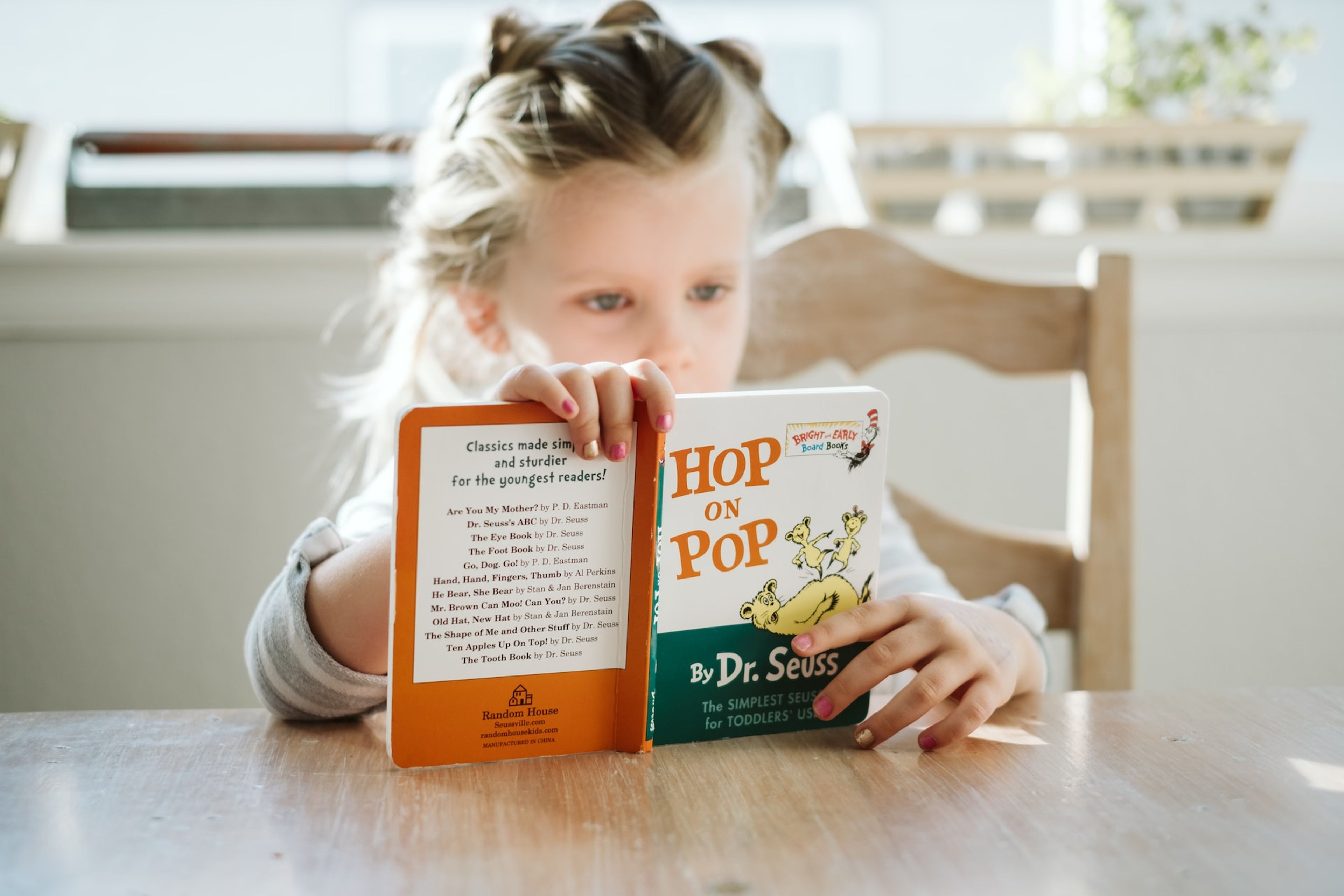
7. Turn the book the right way
Skill: print has a front and a direction.
Try it: Hand them a familiar picture book upside down. Wait. If they turn it, say what they did. If they “read” it upside down, turn it together and start again. NAEYC’s preschool booklet says children learn what reading is for, including that print is read in a direction, alongside hearing sounds in words.
Easier: You turn your own book, they copy with theirs.
A book in another script: Follow the direction of that book. Right to left, or down the page, is the correct direction for that print. Do not “fix” it into left to right.
8. Point along one line
Skill: the order of print.
Try it: Read one line of a book they know. Point under the words as you say them, in the direction the book uses. Their finger can ride on top of yours. One line. Then let them turn the page, which is the part many children want.
The rest of how to read the story, including new words and questions, stays in reading aloud for language. The panel recommends at least one shared reading a day in preschool, using the same book or a different one. Rereading a favorite is the home version.
Easier: You point. They listen.
Stop: Do not point at every word in a long book. One line teaches the direction. The story can continue without the finger.
9. Find the first letter of their name
Skill: one letter name, in real print.
Try it: Write the first letter of their name on a card, uppercase and lowercase. Say the letter name and the sound: “This is M, and it starts Maya.” Then find that letter once in the book or on a box in the kitchen. The panel says to start with letters children already meet, including letters in their names, and to focus on one letter before adding another.
Easier: You point to the letter. They say the name if they want to. Silence is allowed.
Next time: The same letter, in a new place. A second letter waits until this one is familiar.
10. Write that letter once
Skill: the shape of the letter.
Try it: You write it large on paper. They trace it with a finger, then with a crayon, once. Describe the shape with ordinary words: a stick, a bump, a curve. The panel likes a quick look at how the letter is written. A page of repeated letters is a worksheet, and this list does not use one.
Marks that are still scribbles are expected. How those marks develop is in scribbles in early childhood. More ways to use the crayon are in art activities for preschoolers.
Easier: Finger only, no crayon.
Skip: A pen they can uncap and lose, and any small plastic letter.
11. Pick their name from two cards
Skill: their name is a printed word.
Try it: Write their name on one card and a short different word on the other, such as “cup.” Ask which card says their name. By 5 years, most children write some of the letters in their name. Recognizing the whole name can come before writing it. Two cards keep the choice visible.
Easier: Their card has a photo or a sticker they chose, until the letters are enough.
Harder: Three cards, only after two cards are easy. Still no tiny letter tiles.
12. Make a list with one item
Skill: print does a job.
Try it: Say you need one thing from the kitchen, such as milk. They make a mark on the paper. You write the word under their mark. Read it back. NAEYC describes preschool writing as starting in scribbles and later moving toward letter-like shapes. Their mark is the writing for today.
Easier: You write. They point at the word when you read it.
Stop: A ten-item list is your errand, not their game.
13. Say what happens next
Skill: following a story they know.
Try it: Stop once in a book you have read before. Ask what happens next. By 4 years, most children can say what comes next in a well-known story. Accept one word or a point at the picture. Then turn the page and let them see.
Easier: You offer two choices. “Does the dog sit, or does the dog run?”
Stop: Do not quiz every page. One stop, then finish the book for pleasure.
14. Tell two things that happened
Skill: a short retell.
Try it: Close the book. Ask what happened. By 5 years, most children tell a story they heard with at least two events. “The cat was in the tree, and someone helped” is the shape of the CDC example. Two events from your book are enough. If they tell one, you add the second and stop.
Easier: Look at two pictures and say which came first.
Harder: They tell it to a doll or a stuffed animal. One listener is enough.
15. Read one sign outside
Skill: print shows up away from books.
Try it: On a walk or at a window, point to one sign, a package, or a street name. Read one word. If their letter is on it, point to that letter only. The practice guide’s last step is noticing letters in the print that is already around children. One sign is the home version of a labeled classroom.
Easier: The sign is a logo they already recognize, and you still point to one letter.
Skip: A drill of every sign on the street. They will stop looking.
How long, and when to change the game
A few minutes is a full session. The 5-year attention milestone is 5 to 10 minutes during a story or while making something, and screen time does not count. End the sound game while they are still willing, then read the book without the thumbs-up.
Play the same game on another day before you add a new one. The panel’s classroom plan revisits letters and sounds on purpose. At home, “Maya’s letter” all week is a better plan than a new letter every morning.
If rhymes and first sounds stay out of reach for a long time, or they lose a skill they had, talk with their doctor and ask about screening. These games are not a test, and they are not a treatment for a reading difficulty.
Songs with a rhyme do the same listening job. Music toys and rhythm are in music toys. A book, a doll, and a puppet still belong on the shelf for talk, which is covered in the guide to choosing educational toys. The shop is the CottageForTots Shopee store. If a puzzle or a letter set is small enough to swallow, or it is a set of loose magnets, leave it.
What to skip
Do not buy a tub of small magnetic letters for this list. The magnet warning is about pieces that can be swallowed, not about the alphabet.
Do not run a flashcard stack of all 26 letters in one sitting. The evidence-based order is sounds first, then one familiar letter.
Do not correct a home dialect or a home language as if it were a mistake. Start with beginning sounds when end sounds are the hard part.
Do not call letters big and little. Say uppercase and lowercase.
Do not turn the story into a test on every page. One question, then read.
Frequently asked questions
What are reading readiness activities for preschoolers?
They are short games that practice hearing parts of words, and short ways of noticing print. Rhymes, first sounds, clapping a name, turning a book the right way, and finding one letter are the activities on this page.
Do preschoolers need alphabet magnets?
No. Paper, a crayon, and a book cover the print games. Small magnetic letters add a swallowing risk the paper letter does not.
When should a child know every letter?
The CDC milestone at 5 years is naming some letters when you point to them, and writing some letters in their name. “Some” is the word on the list. Knowing all 26 on demand is a later school skill. This page stays with the first letter of their name until that letter is easy to spot.
What if we speak more than one language?
Play the rhyme and the first-sound game in the language you use together. Point along the print in the direction that book uses. NAEYC’s word-play guidance includes home languages on purpose.
How is this different from reading aloud?
Reading aloud is the story, the words, and the back-and-forth. These activities borrow the book for one print move, or they skip the book and use a sound game. Do both. They are not substitutes.
What if my child does not hear the rhyme?
Switch to clapping a name, or to a first sound, and try the rhyme again another day. A few missed games are ordinary. If you are worried about hearing, speech, or a skill they used to have, ask their doctor about screening rather than adding more rounds.
What to try first
Pick a book you have read before. Say “cat, hat,” and ask for a thumb. Then read one page with your finger under the line. If they only want the story, read the story. The sound game can be the walk to the kitchen.
For the age picture of rhymes, letters, and stories, use the CDC lists linked above. For how to sit with the book, start with reading aloud.