Toys for Speech Development: Play That Gets Them Talking

Summary
Toys for speech development work when you talk back. See toy types for naming, pretend, and turns, what to limit, and when to ask a doctor.
A toy helps speech when it gives your child a turn and you take the next one. The useful toy stays quiet until someone plays with it. You name what they are holding, wait, and answer the sound they make. A toy that talks through the whole game leaves them less to say.
This page is for parents of toddlers and preschoolers, about 12 months to 4 years. It is how play and a few generic toy types invite talking: a back-and-forth exchange, a name for an object, a short pretend line, and a turn. The adult is the part that makes the toy work. Shared reading, with one book and one new word, is its own routine in reading aloud. Household pretend scenes for age 3 are in pretend play ideas. Age shelves that include language as one skill among several are in educational toys for 1-year-olds, educational toys for 2-year-olds, educational toys for 3-year-olds, and educational toys for 4-year-olds.
This page is general information for families. It is not medical advice, a screening, or a diagnosis.
The back-and-forth is the activity
The Center on the Developing Child at Harvard University describes serve and return as a responsive, back-and-forth exchange between a young child and a caring adult. When a child babbles, gestures, or cries, and an adult answers with eye contact, words, or a hug, that exchange supports communication and social skills. Naming what a young child is seeing, doing, or feeling helps language connections, even before the child can talk. That description is on Harvard’s serve and return page.
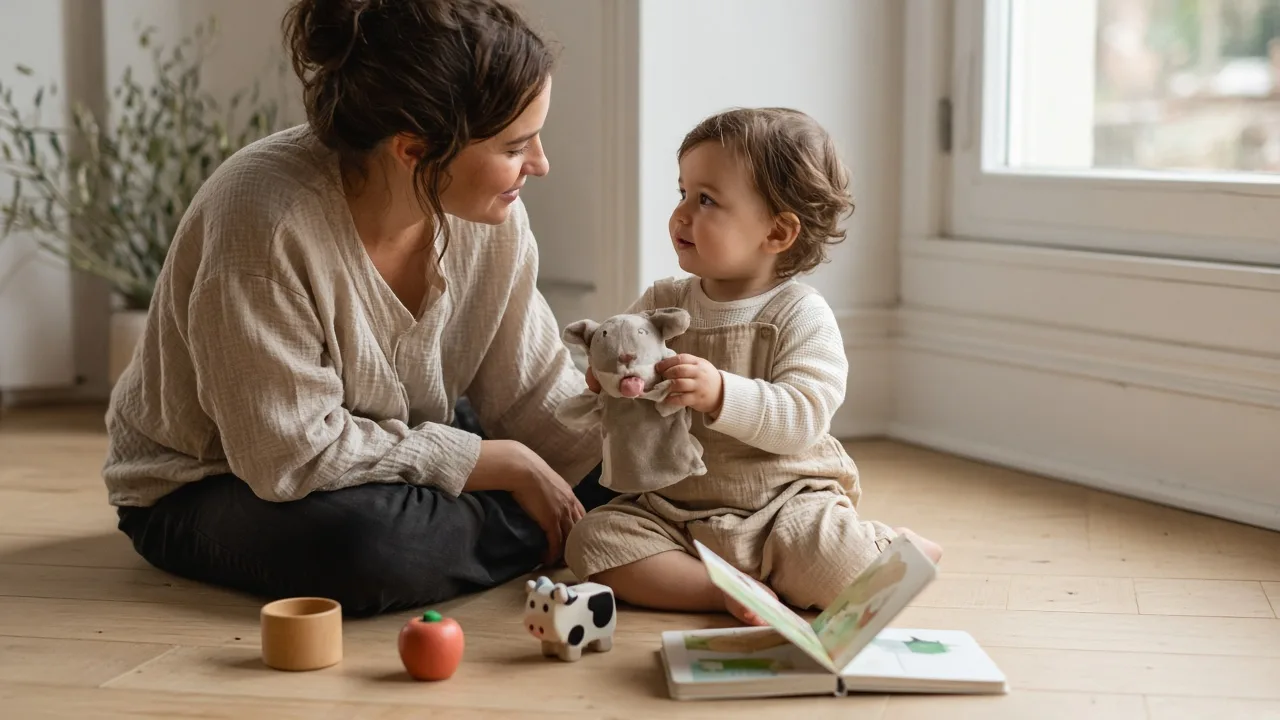
A toy is a reason for one of those exchanges. The child holds up a cup. You say “cup,” then wait. They say “cuh,” or they look. You say “Yes, cup,” and hand it back. That is one serve and one return. A few rounds with one cup is a full session.
The American Academy of Pediatrics clinical report Selecting Appropriate Toys for Young Children in the Digital Era (Healey and Mendelsohn, Pediatrics, 2019) is written for pediatricians to use with families. It describes toys as a way for caregivers to join play that is rich in language, pretending, problem-solving, and creativity. The same report notes a lack of evidence that digital “toys” bring those same developmental benefits.
ASHA, the American Speech-Language-Hearing Association, tells families to talk about what you are doing and what the child sees, to listen and respond, and to use the languages you are most comfortable using. Read in the languages the child is learning. If a word comes out with a sound still forming, say the word the way your family says it and keep the play going. ASHA says not to interrupt a child to correct speech sounds.
A simple look at language milestones
The CDC Learn the Signs. Act Early. checklists describe what most children, 75% or more, do by a given age. Each age page says these materials are not a substitute for a validated screening tool. The wider set, from 2 months through age 5, is in early childhood development. The rows below are language lines only.
| Age | What most children do | One play turn |
|---|---|---|
| 1 year | Waves “bye-bye,” calls a parent “mama,” “dada,” or another special name, and pauses or stops when you say “no” | You name one picture. They may only look. |
| 18 months | Tries three or more words besides “mama” or “dada,” and follows a one-step direction with no gesture, such as “Give it to me” | You offer a spoon so they can pretend to feed a stuffed animal, and you take a turn. |
| 2 years | Points to a picture when you ask “Where is the bear?”, says at least two words together, such as “More milk,” and points to at least two body parts | You answer a short phrase with one added word. “Or nana” can become “You want more banana.” |
| 30 months | Says about 50 words, says two or more words with an action word, such as “Doggie run,” names a picture when you ask “What is this?”, and says words like “I,” “me,” or “we” | You point to one picture and wait for the name. |
| 3 years | Talks with you in at least two back-and-forth exchanges, asks a “who,” “what,” “where,” or “why” question, says what action is happening in a picture, says their first name when asked, and talks well enough for others to understand most of the time | You answer the question, then ask one of your own, and stop. |
| 4 years | Says sentences of four or more words, says some words from a song, story, or nursery rhyme, talks about at least one thing that happened that day, and answers a simple question about what something is for | You join a short pretend scene and let them tell you one thing from the day. |
Those lines are on the CDC checklists for 1 year, 18 months, 2 years, 30 months, 3 years, and 4 years, each reviewed 16 May 2026.
Between the first birthday and 18 months, an earlier line matters. By 15 months most children try one or two words besides “mama” or “dada,” look at a familiar object when you name it, and try to use a phone, a cup, or a book in a simple way. That is the CDC 15-month checklist, reviewed the same day.
ASHA’s communication milestones are a second reference, with ranges such as 13 to 18 months and 2 to 3 years. ASHA says those milestones are not a screening or a diagnostic tool, and that families should also look at the ranges just younger and just older than their child.
You are the part that talks
Put one toy between you. Face the child, near their eye level when you can. The CDC 18-month tips say facing the child helps them see what you are saying, through your face as well as your words.
Then do three things, and stop.
- Name what they are already touching. The CDC 1-year tips say to answer a point with words: “You want the cup? Here is the cup.” If they try the word, notice the try.
- Add one word to what they said. At 15 months, “ba” can become “Ball, yes, that’s a ball,” on the CDC 15-month tips. At 2, “or nana” can become “You want more banana.” At 3, the CDC 3-year tips use the same move with a fuller sentence: “need nana” can become “I want a banana.” ASHA’s activity list (reviewed 6 July 2026) uses the same idea for ages 2 to 4: “Want juice” can become “I have apple juice. Do you want apple juice?”
- Wait. A pause is their turn. If nothing comes, you say the word once and go back to the game. A string of quiz questions ends the play.
Use the languages you speak at home. ASHA lists that as a general tip, and it says to read in the languages the child is learning. The same cup can take a name in whichever language you are speaking. You do not need a separate toy for each language.
One comment is enough. “You gave the cow a drink” names what they did. Then be quiet long enough for them to do it again.
Toy types that leave room for a word
These are types. The way you play them is the same: they do something, you name it, you wait. NAEYC’s toy lists include toy phones, dolls, puppets, stuffed toys, plastic animals, and play food on the 1-year-old and 2-year-old lists, and puppets again for ages 3 to 6. NAEYC says each child has their own pace, and a safe toy from another age list can still fit.
Picture books and lift-the-flap books
The CDC 1-year tips say reading can be talking about pictures, and that babies this age like books they can feel or flaps they can lift. By 18 months most children look at a few pages with you. By 2 years most point to a picture when you ask where it is. By 30 months most name the picture when you point and ask what it is.
The routine for one book, one new word, and one question is in reading aloud. Rhymes and first sounds, closer to ages 4 and 5, are in reading readiness activities. If a flap tears off, use the size check in safe toys for toddlers before that book goes back on the floor.
Look for: a board book they can hold, with one flap or one texture, and pictures of things they see at home.
Skip: a book that reads itself while you both watch. You are the voice.
Play kitchen and food sets
By 2 years most children play with more than one toy at once, such as putting toy food on a toy plate. By 30 months the CDC tips say to let them pretend to cook with safe things from your kitchen. ASHA’s list for ages 2 to 4 includes talking about things to eat as a category.
Hand them one food and one plate. “Banana on the plate.” Wait. If they say “nana,” you add the rest. The six short household scenes, with a pot and a doll, are in pretend play ideas for 3-year-olds. Feeling words for the same doll are in social-emotional toys.
Look for: a few large pieces, a cup, a plate, and food that stays in one piece when you tug it.
Skip: a large set they will not use, and any piece small enough to fail the check on the safe-toys page if anyone in the room is under 3. Real kitchen knives stay in the drawer.
Puppets
ASHA suggests a puppet show for ages 2 to 4: dolls or homemade puppets, a funny voice, and talk about who the character is, what they want, and how they feel. Keep it to one sentence from the puppet. “The dog is hungry.” Then wait for them to feed it or to say a word.
The CDC 15-month tips say to “pretend talk” with a stuffed animal and see if the child copies you, or uses another animal to answer. That is the younger version of the same game. One puppet is enough.
Look for: a puppet whose eyes and mouth are stitched or printed, with no loose buttons.
Skip: a puppet that plays a recorded scene. The child should be the one who talks.
Toy phones
NAEYC lists toy phones among pretend toys for 1-year-olds. The CDC 15-month checklist includes trying to use a phone the way it is used. Hold a toy phone, or a wooden block, to your ear. Say “Hello.” Pause. Offer it to them. Their babble is the answer. You say “Hello, I hear you,” and end the call.
A real phone with a screen is a different object. Screen limits are in balancing screen time.
Look for: a phone with no screen, large enough to pass the size check on the safe-toys page, and a battery door they cannot open. Button batteries are on that same page.
Skip: a phone that holds the conversation for them, and any phone whose battery door a toddler can open.
Farm and animal sets
ASHA’s birth-to-2 tips say to talk about animal sounds so the child can connect the sound and the animal: “The dog says woof-woof.” The CDC 18-month tips use the same add-on: if they say “dog,” you can say “Yes, that’s a dog. Dogs say woof.”
Set out two animals. Name the one they grab. Make the sound once. Wait to see if they try it. By 2 years, an animal puzzle works the same way: the CDC tips say to name each piece when the child puts it in place.
Look for: a few chunky animals that stay whole, or a simple animal puzzle with large pieces.
Skip: tiny animals from a large playset, and loose magnets. Those checks are on the safe-toys page.
Simple turn-taking games
A turn is language practice because someone has to wait and then respond. The CDC 18-month tips include rolling a ball back and forth. The 2-year tips say to take turns building a tower and knocking it down. By 3 years most children can keep a conversation going for at least two back-and-forth exchanges. By 4, the CDC tips say to help a child ask “Can I have a turn?” and to keep teaching turns with other children.
Say “my turn,” hand the ball, and say “your turn.” That pair of words is the whole game. Games where the goal is shared are in cooperative play toys. A rules game for ages 4 to 6 is a later step, in educational board games.
Look for: one ball much larger than the child’s mouth, or a few blocks you can pass.
Skip: a game with a long rulebook, and any electronic game that announces the winner.
Music the child has to make, such as a drum or a shaker, can be another turn: you tap, they tap. How to choose that toy by the sound the child makes is in music toys. This page leaves that list where it is.
What to limit
Two kinds of toys do the talking for the child.
Talking electronic toys. In a study of 26 parent-infant pairs, infants 10 to 16 months old, play with electronic toys came with fewer adult words, fewer conversational turns, fewer parent responses, and fewer content-specific words than play with books or traditional toys. Children also vocalized less during electronic-toy play than during books (Sosa, JAMA Pediatrics, 2016). The paper’s conclusion says that, to promote early language development, play with electronic toys should be discouraged, and that traditional toys are a useful stand-in when book reading is not the activity the child wants. The sample is infants, in one short session. It is a reason to prefer a toy that waits.
A single large button the child presses, so something happens, is the cause-and-effect the CDC 2-year tips describe. That is a different toy from one that speaks every line.
Screens. Before age 2, the CDC 1-year and 18-month pages say to limit screens to video calls with people the child knows, and that other screen time is not recommended. From 2 years through 4 years, the 2-year, 3-year, and 4-year pages say no more than 1 hour a day of a children’s program with an adult there. Children learn by talking, playing, and being with people. ASHA’s general tips also say to set limits on screen time and to use that time for talking, reading, and playing together. How to write the plan, and what the American Academy of Pediatrics said in 2026, is in balancing screen time.
If a screen is on, sit with them and talk about what you both see, then turn it off and go back to the cup or the puppet.
Toy ideas by type
These are types, not products. No brand, price, or rating belongs in this list. The last column stays empty until a specific toy is chosen. Until then, a cup from the kitchen can stand in for the food, and a sock on your hand can stand in for the puppet.
| Toy type | How it invites talking | What you say once | Product pick |
|---|---|---|---|
| Picture book or lift-the-flap book | Naming a picture, then waiting | “Where is the bear?” or the name of one picture | None yet |
| Play kitchen or food set | A request, a name, a short pretend line | “Banana on the plate.” | None yet |
| Puppet or stuffed animal | One line of dialogue, then their answer | “The dog is hungry.” | None yet |
| Toy phone with no screen | A hello, a pause, a goodbye | “Hello.” Then you wait. | None yet |
| Farm or animal set, a few pieces | A name and one animal sound | “Dog. Dogs say woof.” | None yet |
| Ball or a few blocks for turns | “My turn” and “your turn” | “Your turn.” | None yet |
Buy when that type is missing, broken, or too small for a child who still mouths toys. You do not need one of each. A book and a cup cover naming and pretend. The ball covers the turn.
When to talk with a doctor or a speech-language pathologist
You know your child best. The CDC milestone pages say not to wait if your child is not meeting one or more milestones, has lost skills they used to have, or you have other concerns. Talk with your child’s doctor, share what you see, and ask about developmental screening. If you and the doctor are still concerned, the same pages say to ask for a referral to a specialist and to call your state or territory’s early intervention program. How monitoring at home differs from a formal screening questionnaire is on the CDC page developmental monitoring and screening.
ASHA says to talk with a speech-language pathologist if you are worried about a child’s speech or language, and with an audiologist if you are worried about hearing. Its milestone tips include having hearing tested if you find yourself repeating a lot or using a loud voice. ASHA also says not to wait: getting help early can stop later problems with behavior, learning, reading, and social relationships. Its milestone page says the lists are not a screening or a diagnostic tool.
A toy does not replace that conversation. This page cannot tell you whether your child needs an evaluation. A doctor or a speech-language pathologist can.
Frequently asked questions
What toys help toddlers talk?
Toys that give the child something to name, request, or answer, while you talk back. A picture book, a few pieces of play food, a puppet, a toy phone with no screen, two animals, and a ball you roll back and forth are the types on this page. People looking for toys that encourage talking, or toys to help toddlers talk, are usually looking for that back-and-forth. The toy stays quiet until someone plays.
Do electronic talking toys help speech?
In the Sosa study of infants 10 to 16 months, electronic toys came with less parent talk and fewer conversational turns than books or traditional toys. The AAP clinical report notes a lack of evidence that digital toys bring the same benefits as play with a caregiver. A button the child presses can still teach cause and effect. A toy that speaks the whole game leaves them less to say.
What are language development toys for toddlers?
The same short list. Language development toys for toddlers are ordinary toys you talk about: books, pretend food, animals, and a turn-taking game. NAEYC includes those types on its 1-year-old and 2-year-old lists. There is no ranked set, and no brand on this page.
How many of these toys do we need?
One at a time. There is no official number of toys for a speech shelf. Put out the one they are already handing you. How to store the rest and swap later is in how to set up a toy rotation.
When should I ask a doctor about speech?
When a milestone on the CDC list is missing and it worries you, when a skill has dropped away, or when you have another concern. Ask the doctor about developmental screening. If the worry is speech or language, ASHA says to talk with a speech-language pathologist, and not to wait. If the worry is hearing, ASHA says to talk with an audiologist. This page is not a screening.
Can we use more than one language during play?
Yes. ASHA says to talk and read in the languages you are comfortable using, including the languages the child is learning. Use the same cup, and name it in the language you are speaking.
What to try first
Watch one play session. Notice what they already hand you: a book, a cup, an animal, a ball. Use that object for one name, one wait, and one answer. Leave the other types for another day.
If the missing piece is the book routine, open reading aloud. If the missing piece is a short pretend scene with things you already own, open pretend play ideas. If a milestone worries you, talk with your child’s doctor before you buy another toy.