Children's Outdoor Swing Set: A Practical Guide for Singapore Parents

Summary
Choose a children's outdoor swing set by seat, space, and fall surface. Clearance, anchoring, weather, and what to ask before you buy.
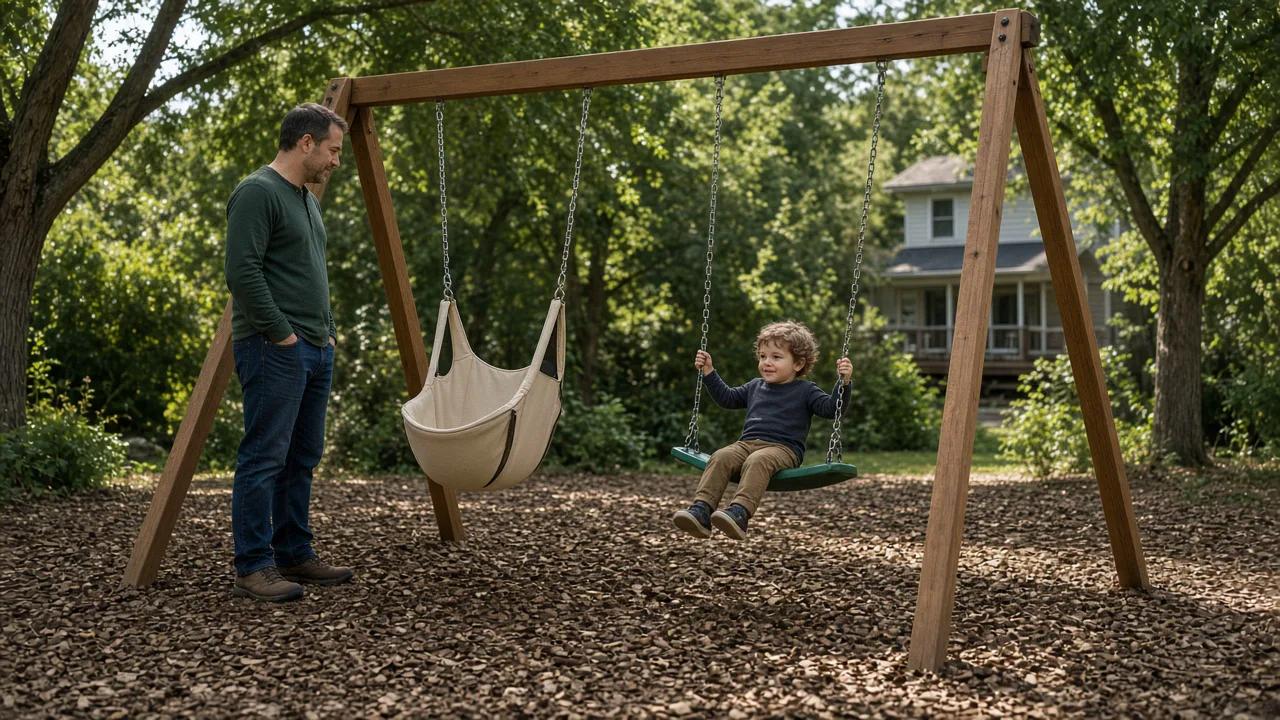
A children’s outdoor swing set is a frame you anchor outside, with seats a child sits in while they move. Match the seat to this month, the frame to the clearance you measured, and the session to an adult who stays. Follow the manufacturer’s age range.
An indoor infant swing is a different product. Time and sleep limits for that seat are in how to choose a baby play mat.
Quick answer: If you lift your child in, use a full-support bucket seat and stay. A belt seat is the open seat public-playground guidance lists from the preschool years: one child, a soft seat. If twice the bar height will not fit in front of the swing and again behind it, the site is too small. Anchor from the manual, over a shock-absorbing surface. Grass is not that surface.
What to look for in a children's outdoor swing set
The U.S. Consumer Product Safety Commission’s Public Playground Safety Handbook (Publication 325, July 2025) is guidance for public playgrounds from 6 months through 12 years, not a mandatory rule. Toddlers and preschool-age children need closer supervision than older children, paired with the right seat and surface.
| Seat | Who it is described for | Check that day |
|---|---|---|
| Full-support bucket | About 6 to 23 months, generally under 4, and still listed for ages 2 to 4. An adult helps the child in and out. | Sides, a between-the-legs support, a fastened restraint, and you beside the seat. |
| Belt seat | About 2 to 5 years, and about 5 to 12. One user. | Rubber, plastic, or canvas. The child sits and holds on. |
| This set’s label | The maker’s age, weight, and restraint. | When the label and the child disagree, follow the label. |
The home handbook (Publication 324, 2005) says never to leave a child in a toddler swing unattended. The American Academy of Pediatrics names those soft materials on HealthyChildren.org (updated 19 June 2017).
CDC lists say what most children, 75% or more, do by an age, and they are not a screening tool. By 2 years most children run, and by 30 months most jump with both feet. A ball, a push toy, or a low climber still belongs in the week. See gross motor toys for toddlers, gross versus fine motor skills, and early childhood milestones.
Publication 324 places equipment at least 6 feet from a house, fence, shed, tree, or pole, and a swing twice the bar height in front and behind. Surfacing covers that area. A slide should not exit into the swing. Leave 8 inches between swings with limited side motion, and 8 inches under the seat. The AAP backyard page (updated 28 June 2022) says at least 6 feet from walls and fences. Use the larger front-and-back distance. A private yard follows the manual and Publication 324. Publication 325 uses twice the pivot height for a public belt swing, and twice the seat-to-pivot height for a bucket.
Paint or galvanize metal, with no lead in the paint. Use rot-resistant wood, such as cedar or redwood, or wood treated for outdoors. Skip creosote, pesticide coatings, and CCA-treated wood, out of residential use since 31 December 2003 because it contains arsenic. Match bolts to newer treatments. Close S-hooks to under a dime’s thickness (0.04 inches). Skip fiber ropes and horizontal A-frame crossbars.
Swing set ideas by type
Types only. The product column stays empty until the manual agrees.
| Type | What it is | When it tends to fit | Product pick |
|---|---|---|---|
| Toddler bucket-seat swing set | Full-support seat and a restraint | A child you lift in, with you beside them | None yet |
| Freestanding single swing | One seat on its own frame | Clearance for one arc, one child at a time | None yet |
| A-frame metal set | Metal frame, one or two seats | Named rust protection, soft seats, shade, no crossbar | None yet |
| Wooden playset with swings | Wood frame, maybe a platform or slide | Outdoor-rated wood, slide missing the swing path | None yet |
Remove swings hung from monkey bars, and keep public-playground swings off composite structures.
Outdoor swing set safety checklist
Publication 324’s 2005 edition says about 50,000 children a year reached U.S. emergency departments for home-playground injuries, about 80% of them falls. Deaths it describes came from caught ropes or clothing, a trapped head or neck, a fall, or a set that tipped. This list does not promise zero injuries.
- Level ground and the manual’s hardware, tightened. Bury anchors or cover them with the surface.
- Feel metal before play. Direct sun can make it burn in seconds. Shoes stay on.
- Keep a tested surface. Publication 324: at least 9 inches of wood mulch, chips, engineered wood fiber, or shredded rubber for equipment up to 8 feet, and 9 inches of sand or pea gravel up to 5 feet. A 12-inch fill packs to about 9. Under 4 feet, at least 6 inches. No loose fill on concrete or asphalt. Grass, dirt, carpet, and thin mats do not count. The AAP asks for 12 inches of sand, mulch, or chips, or tested tiles. Where depths differ, follow the manual and an ASTM F1292 report for the fall height. Rake and refill.
- Openings under 3½ inches or over 9 inches.
- Nothing tied on. Helmets, drawstrings, and necklaces come off. A chin strap has strangled children when a helmet caught.
- One child in a belt seat. Discourage stomach swinging, standing, and jumping off.
- You stay. The AAP says to take a younger child inside with you. The CDC playground sheet says serious brain injuries are more likely on monkey bars, climbers, and swings (Cheng and colleagues, Pediatrics, 2015).
Check bolts, caps, and plugs twice a month. Check hangers monthly. Repaint rust with lead-free paint. Keep the model and manufacturer page so you can order parts.
How to choose a swing set for a Singapore home
A balcony, a narrow yard, or a shared lawn often cannot hold twice the bar height in front and behind, where you can see the arc. People crossing a walkway are in the use zone.
A slope raises the chance of a tip and washes fill away. Standing water packs it, so drain the site and recheck depth after a storm. Shade the frame, and look for rust on humid weeks. Wait until a hot seat is cool to your hand.
CDC outdoor-play notes add shade, a hat, covering clothes, and, with permission, sunscreen of SPF 15 or higher after 6 months. Apply it 30 minutes ahead and at least every 2 hours.
Ask the landlord or manager in writing before you anchor anything. This page states no Singapore installation law. Publication 324 covers homes and residential child care, and it sends multiple-family dwellings to the public handbook. SS 457:2017 is a public-playground specification. Section 1.3 of the preview leaves home playground equipment out of scope. Ask a shared playground which standard it uses.
Singapore’s Consumer Product Safety Office says children’s products and sports goods need no pre-market approval, and that they must meet an applicable ISO, IEC, EN, or ASTM standard plus the CGSR booklet. Ask which standard, and whether a chain or seat can be replaced. Check the alerts page linked there. Stop if you see cracks. Remove a seat only when the manual says so.
What children can practise through swing play
Swinging can support balance, timing, and a turn while you push, because one belt seat holds one child. The CDC’s 30-month tips use a swing for “Ready, set…”, a wait, then “Go.”
NAEYC says each child has their own pace, and its 2-year-old climber is low with something soft underneath. Floor games are in indoor gross motor activities. Wheels are in children’s riding toys. WHO’s 2019 guidelines set at least 180 minutes of activity a day for ages 1 to 4, spread out. A few pushes are one piece.
A 2020 review of swinging as therapy in cerebral palsy found five studies, uneven doses, and no clinical recommendation (Topley, McConnell, and Kerr, PubMed 32212976). It is not a buying reason.
Questions to ask before buying a child's outdoor swing set
Is it suitable for my child's current stage?
Lift-in children need the bucket, the restraint, and you. A belt waits until the child can sit and hold on and the label agrees. Ask the weight limit.
Can the installation site accommodate the required clearance?
Twice the bar height in front and behind, and at least 6 feet from walls and paths, surfacing included. A short tape measure means the set does not fit.
What maintenance and weather protection are needed?
Ask about rust protection, wood treatment, and removable seats, then use the bolt, hanger, rain, and heat checks above.
What happens if the swing is shared by siblings?
One child per belt seat. A bucket needs an adult at every entry. Give it a separate bay when you can. Keep slides out of the swing path.
What instructions, warranty, and replacement parts are provided?
Ask for the anchor method, the standard, the warranty, and a parts list with the manufacturer and model. Without that sheet you cannot reorder a chain or a bolt.
Outdoor swing set alternatives for smaller spaces
A public playground still needs age-right equipment, a soft surface, nothing tied on, helmets off, and you within reach of a toddler. At home, use a ball, a push toy, or a floor game from the linked guides, with an adult there. Small parts, magnets, and cords are in safe toys for toddlers. If a movement is missing, or a skill has dropped away, the CDC says to ask the doctor about screening.
References
- Outdoor Home Playground Safety Handbook, Publication 324 (U.S. Consumer Product Safety Commission, 2005)
- Public Playground Safety Handbook, Publication 325 (U.S. Consumer Product Safety Commission, July 2025)
- Summer Safety Tips: Staying Safe Outdoors (HealthyChildren.org, American Academy of Pediatrics, updated 19 June 2017)
- Playing Outside in the Yard (HealthyChildren.org, American Academy of Pediatrics, updated 28 June 2022)
- Playground safety tips for parents (CDC HEADS UP), citing Cheng and colleagues, Pediatrics, 2015
- Milestones by 2 years and milestones by 30 months (CDC)
- Outdoor play and safety in early care (CDC)
- Good toys for young children by age (NAEYC)
- To grow up healthy, children need to sit less and play more (World Health Organization, 24 April 2019)
- A systematic review of vestibular stimulation in cerebral palsy (Topley, McConnell, and Kerr, Disability and Rehabilitation, 2020)
- Choose safer consumer goods (Singapore Consumer Product Safety Office)
- SS 457:2017 preview (Singapore Standards; home playground equipment is outside the stated scope)